

Mental health can be a challenge for many of us. From effects in our daily lives to crises that need professional assistance, even finding the willpower to ask for help can be a tall order.
Sometimes, even that is a bridge too far.
What can you do if you have a loved one, a friend, a family member, or even a neighbor who is clearly in crisis but refuses to seek assistance?
The answer is the mental health petition process. The state of Michigan maintains a court process for mental health assistance petitions, which allows you to get the government involved and help people get the assistance they need.
Are you experiencing or witnessing a crisis? Don't hesitate; call 988. 988 is your direct, free, 24/7 access line to mental health crisis care in the state of Michigan. Trained specialists will help you through your crisis, or help handle a crisis you're seeing in someone else. Emergency assistance is available for these crises, so don't delay.
DISCLAIMER: This article is for informational and educational purposes only and should not be considered medical or psychological advice. The information presented here is not intended to diagnose, treat, cure, or prevent any mental health condition or replace professional therapeutic care. Every individual's experience with trauma and mental health is unique. Please consult with a qualified mental health professional, therapist, or healthcare provider to determine the most appropriate treatment approach for your specific situation. If you are experiencing a mental health crisis or emergency, please contact your local emergency services or crisis hotline immediately.
First, Another Disclaimer
Before we dig into this topic, and in addition to our usual medical advice disclaimer, we'd like to make an additional disclaimer. We are not lawyers or legal experts, and the information in this article is not meant to constitute legal advice.

Since the mental health petition process involves the probate court system, there can be a lot of intricacies involved that can't be covered in a blog post. Always verify with a lawyer or court expert to make sure you're handling things properly.
We've done our best to provide accurate information, but if you run into a contradiction, or if things change since the last time we've updated this post, talk to court officials for the most accurate advice.
What is a Mental Health Petition?
A mental health petition is a mechanism that the government offers. It's a way for individuals, including concerned citizens, to petition the courts to get a person treatment for mental health issues.
In order for this process to be effective and to avoid it being abused, it's a fairly serious system. As the concerned citizen, you have to file a petition with the probate court, attesting to witnessing behavior that meets the legal definition of a person requiring treatment. You will be asked to present testimony before the court.
If the court agrees that the individual needs treatment, they can then order that treatment. Court-ordered treatment for mental illness can range from mandated outpatient therapy to assisted outpatient to inpatient treatment, depending on the evaluation of the patient.

There are a lot of specifics that must be met for this petition to be granted, which we'll cover throughout this post. When in doubt, talk to the probate court of Oakland County for more information.
If the court decides the evidence is insufficient, they won't pass the petition, and nothing will happen. If the court decides that the evidence is sufficient to grant the petition, the patient will be evaluated by a mental health professional with Common Ground Crisis Services. If that judgment proceeds, the patient will be enrolled in the relevant treatment. If it does not, the patient will be released.
One key detail that the court must consider is whether or not the patient meets the legal definition of a Person Requiring Treatment.
What is the Definition of a Person Requiring Treatment?
In order to file a mental health petition, the person you're filing for has to meet certain criteria.
First, the legal definition of mental illness.
"A substantial disorder of thought or mood that significantly impairs judgment, behavior, capacity to recognize reality, or ability to cope with the ordinary demands of life."
There are many ways that mental illness can be expressed in life, and there are many unhealthy coping strategies that can be harmful, but they may not meet the legal standard necessary to involve the courts. The bar is high for a reason, and while it can feel like a barrier to care, it's also a barrier against abuse.

In order for a patient to be eligible for the mental health petition process, they must have a mental illness as defined above, and they must also be a "Person Requiring Treatment." This is a specific legal definition in the Michigan State Law under MCL 330.1401. To file a petition, the patient must meet one or more of the following:
- "Can reasonably be expected within the near future to intentionally or unintentionally seriously harm himself/herself or another person, and who has already done so or threatened to do so, OR
- Is unable to attend to his/her basic physical needs such as food, clothing, or shelter, OR
- Is unable to understand his/her need for treatment, which may result in significant physical harm to himself/herself or to others."
Someone experiencing a temporary crisis likely does not meet this definition. Instead, seek out one of the many Detroit-area crisis care options that are available.
Additionally, if the patient is a minor, the standards are a little different. You can read more about that in our guide to helping teens who don't want therapy.
Finally, the patient must be a resident of Oakland County to be subject to the Oakland County Probate Court.
There are many cases where an individual might seem like they meet the definition, but don't. Individuals with age-related dementia, epilepsy, alcoholism, substance use disorder, homelessness, or other issues likely do not meet the definition simply by having those issues.
Who can File a Mental Health Petition?
One myth surrounding the mental health petition process is that only a relative or close family member can file the petition. This isn't true.
In fact, any adult 18 years of age or older who witnesses behavior indicative of a Person Requiring Treatment is allowed to file the petition. You must have witnessed the behavior within the last 14 days to file; if it has been longer than two weeks, the petition won't be valid.

Many mental health petitions are filed not by friends or family, but by concerned neighbors, or even by authorities such as police or doctors. The petition process is meant to help people get care when they are incapable of seeking it themselves, or when they present a clear and present danger to themselves or others around them.
What Information Do You Need to File a Mental Health Petition?
The petition paperwork to file a mental health petition can be found here.
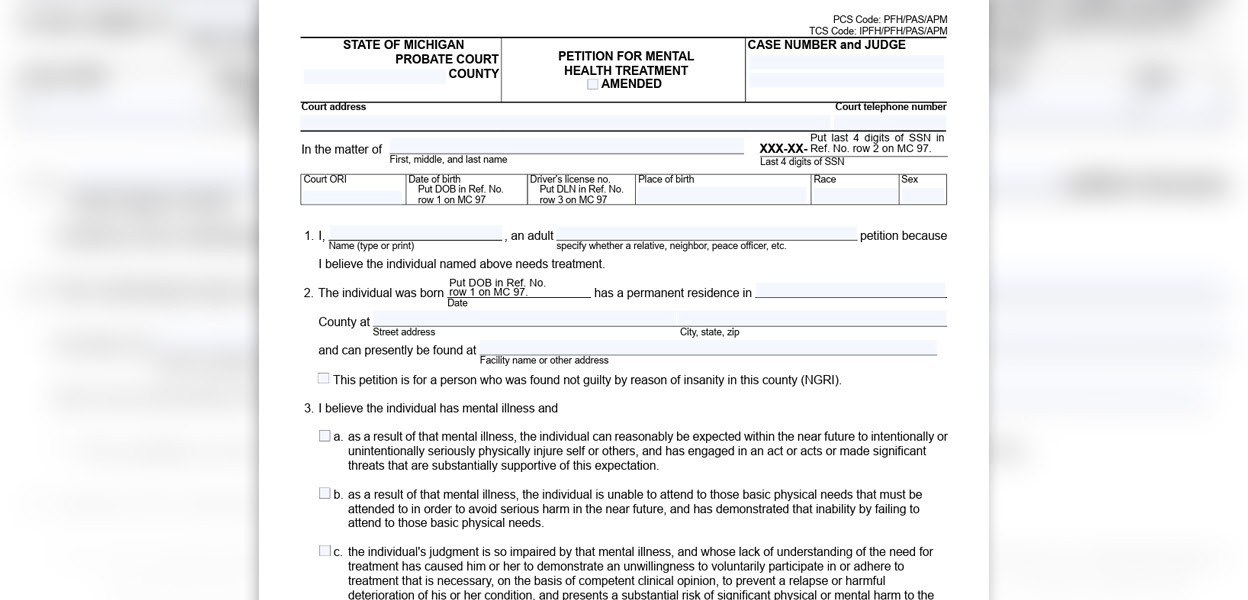
Information you will need to provide includes:
- The name of the patient.
- Information about the patient, including address, birthplace, race, and gender.
- Your name and relationship to the patient.
- Attestation that you believe the patient requires treatment.
- A description of your observations of the actions or statements the patient has made that indicate a Person Requiring Treatment.
- Information about interested parties, such as the patient's spouse or family.
- Information about current treatment or hospitalization.
- Whether or not you're requesting protective custody.
- The type of treatment you're requesting, whether it's assisted outpatient, inpatient, or both.
- Your name, address, contact information, and other information.
You may not have some of this information, and that's fine. Talk to court officials if you're missing information but still want to file the petition.
What Does it Cost to File a Mental Health Petition?
There is no filing fee for a mental health petition with the Oakland County Probate Court. The court has many different fees for different kinds of paperwork, which you can view on their fee schedule page.
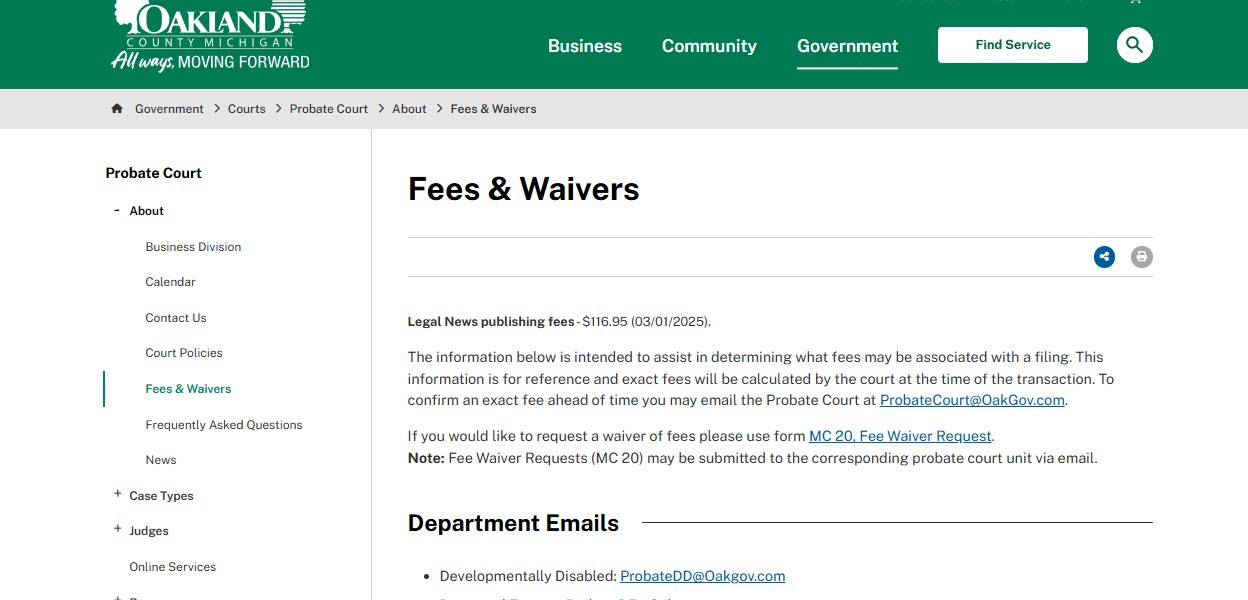
In cases where another fee is relevant, waivers may also be granted. As usual, talk to the court directly if you have questions about potential fees.
What is the Mental Health Petition Process Like?
When you witness behavior that you believe constitutes that of a Person Requiring Treatment, you can fill out and submit the petition paperwork to the court within 14 days.
Depending on your selections on the petition, the patient may be picked up by a crisis team or by police and placed into protective custody or hospitalized during a crisis. Otherwise, they may be notified and requested to visit one of the local mental health facilities for evaluation.
Evaluation requires two doctors, at least one of which must be a psychiatrist, to evaluate a patient. If the doctors feel that a patient is in need of treatment, they will be transported to a relevant facility for that treatment. Local hospitals, including Ascension, Havenwyck, Kingswood, McClaren, Pontiac General, and Trinity Health are all available options.

Often, a patient is transported to a hospital, where a doctor reviews them; if the doctor certifies they need treatment, they are then transported to a mental health facility for a psychiatrist to evaluate them. If the psychiatrist agrees, both attestations and the petition are forwarded to the court.
If the doctor or psychiatrist do not believe the patient requires treatment, they can be released immediately. Alternatively, if they are in a crisis but don't meet the Person Requiring Treatment definition, they can be offered crisis care.
If the petition advances, a court hearing is set for some time in the following week, and the patient is appointed an attorney. During the hearing, the court will review the petition and your testimony, as well as the statements from the doctor and psychiatrist. They will make a decision and proceed with one of the possible outcomes:
- Dismissal; insufficient evidence that the patient requires treatment, and they will be released.
- Voluntary Treatment; the patient agrees they need help and will enroll in consensual treatment.
- Assisted Outpatient Treatment; the patient may be legally required to attend treatment, but is not hospitalized for it. This can last for up to 180 days.
- Involuntary Commitment; the patient is found in need of treatment and is hospitalized for up to 60 days.
In extremely rare cases, a patient may be fully unable to handle their affairs even with treatment, and the proceedings can be converted into a petition for guardianship. This is an entirely different process and is outside the scope of today's article, however.
What Other Resources are Available for More Information?
The mental health petition process is well-documented with the Oakland County probate court system.
First, you can read this brochure, which outlines much of what we've covered here today, as well as some details that are relevant to other situations. It can help you clarify your situation and determine if a petition is the correct move in your circumstances.
Next is this form. Since the petition form itself is somewhat complex, this PDF is an annotated version of the form that gives you more information on what data to put into which fields. It's like a guidebook to filling out the petition form.
If you have filled out a petition in the past and had it granted, but the court-ordered treatment is about to expire, and the patient still needs more treatment, you can file a second petition. This requires a second form, PCM 218, which is the Petition for Second Mental Health Treatment Order form.

You can also contact the probate court directly for further information. They can be reached through various means.
- Phone: 248.858.0291
- Email: ProbateMI@Oakgov.com
- Website Contact Form
- In Person: 1200 N Telegraph Rd. Department 457, Pontiac, MI, 48341
The Oakland County Probate Court's hours are Monday through Friday, from 8:30 am to 4:30 pm. Holidays can affect these hours; the holiday schedule can be found here.
Additional forms related to mental health and the Probate Court of Oakland County can be found on this page.
At BMC-Troy, we do our best to keep Detroit-area residents informed of the options available for care, both for themselves and for their loved ones. We aren't an emergency care facility, but we do provide cutting-edge therapy for a wide range of mental illnesses. We can also help with medication management to facilitate the best possible treatment for your needs. To get started, you can fill out our new patient intake form or call our office directly at 248.528.9000. We'd love to hear from you, and we're happy to help.