

Many people with a mental illness find support and comfort in their pets. Dogs especially are a common sight accompanying people with both mental and physical illnesses, but many different animals can serve the role of an emotional support animal, including cats, rabbits, miniature pigs, and birds.
Support animals are both commonplace and broadly accepted. A well-trained dog acting as a service animal can do everything from help a low-vision individual navigate the world, to alert to potential medical issues in a person with a seizure disorder, and much more.
Emotional support animals are a little different. Rather than being deeply trained service animals, emotional support animals tend to provide support more by their presence than their actions.
Unfortunately, there has been a lot of abuse of the emotional support animal laws across the country and right here in Michigan. People buy letters online proclaiming their pets to be emotional support animals, and threaten legal challenges against anyone who asks questions about them. They exploit a lack of awareness and an official-looking letter to gain access for their pets to places where those pets shouldn't be.
Because of this abuse, it's important to understand the difference between a service animal and an emotional support animal, what a letter does and how to get one, and what that letter does (and does not) do for you.
We believe that anyone with the need should be able to access an emotional support animal when that animal can genuinely help them. We're not opposed to the concept at all. We just want to help clarify the rules, to help put a stop to the people who abuse those rules and jeopardize the access to support animals for everyone.
DISCLAIMER: This article is for informational and educational purposes only and should not be considered medical or psychological advice. The information presented here is not intended to diagnose, treat, cure, or prevent any mental health condition or replace professional therapeutic care. Every individual's experience with trauma and mental health is unique. Please consult with a qualified mental health professional, therapist, or healthcare provider to determine the most appropriate treatment approach for your specific situation. If you are experiencing a mental health crisis or emergency, please contact your local emergency services or crisis hotline immediately.
Service Animals vs Emotional Support Animals
First, some definitions. There are two main categories of support animals, at least as far as the law is concerned: service animals and emotional support animals.
Service animals are the more restrictive, higher-bar kind of support animal. They're regulated by the Americans with Disabilities Act here in the United States, with high standards for training and service, strict rules to follow, and more.
Service animals are highly trained to perform specific sets of tasks for individuals with disabilities. They might be sight dogs for the blind, alert dogs for medical conditions, comfort dogs for those with PTSD or severe anxiety, and similar functions. Some even keep track of time and alert their owners to take their medications each day.
Service animals are very restricted. Only dogs and miniature horses can be service animals, and they have to meet high standards of training to be considered a service animal.
Service dogs are the ones with the broadest freedoms, because they are the most well-trained and constitute an accessibility aid for their owners. They are allowed in places where animals are normally prohibited, like hospital rooms, cafeterias, airplanes, businesses, public spaces, and more. They can still be prohibited from some environments (such as sterile operating rooms), but they're broadly allowed just as widely as something like a cane or a hearing aid would be.

Emotional support animals are different. ESAs are companion animals whose primary purpose is to provide emotional and mental support. This is a function that some service dogs can provide as well, but the bar is much lower.
ESAs don't need to be as highly trained. They don't need to be able to perform specific tasks, and their owners don't need to be diagnosed with a disability to acquire them. The ADA doesn't govern emotional support animals, either.
There are also other kinds of animals that can come up, like therapy animals. These are working animals that you can think of more like employees of a facility, instead of an animal you own. For example, a hospital might have a working dog that comforts children going in for surgeries.
Fast Facts About Emotional Support Animals
Let's cover some of the most important details of emotional support animals and how they work.
Nearly any domesticated animal can be an emotional support animal.
Where service animals are required to be dogs or, sometimes, miniature horses, the restrictions on emotional support animals are much more lax.
To be an emotional support animal, the animal must provide comfort to their owner and be legal to own. There are also some exclusions.
This means dogs, cats, birds, some lizards and snakes, even pets like spiders can be emotional support animals.
On the other hand, exotic animals like big cats, non-domesticated animals like raccoons and opossums, and dangerous animals like bears or venomous snakes aren't allowed.
Additionally, many rules about emotional support animals also prohibit farm animals. A miniature horse or miniature pig might be allowed, but a full-size horse, a cow, or a chicken generally won't be allowed.

ESAs are also governed by local laws. It might be legal to own a particular animal in one state but not another. It can be allowed as an ESA in the place where it's legal, but not where it's illegal. Certain small wildcats often fall into this category.
Emotional support animals are not licensed or certified.
Service animals are often thought of as certified or licensed, but they really aren't. The proof is in their behavior; service animals are exceptionally well-trained. Here in Michigan, service animals can be registered voluntarily, but it's not a requirement to have one.
Emotional support animals, likewise, are not certified or licensed. More importantly, claiming an emotional support animal is a service animal (and registering them with the state) is a misdemeanor punishable by potential fines, community service, or jail time.

Because there's no authority licensing service animals, landlords are not allowed to require an identification or registration to allow access to a service animal. The above link also has the form for filing a complaint, if it occurs. This, again, applies to service animals, not emotional support animals.
Emotional support animals have some access, but not much.
As mentioned, service animals have a lot of access as an accessibility aid under the ADA.
Emotional support animals are not service animals and are not regulated under the ADA. Instead, they are governed under two other pieces of legislation: the Air Carrier Access Act and the Fair Housing Act.
The Air Carrier Access Act is what requires airlines to allow service animals. In the past, it also required airlines to allow emotional support animals. However, after a lot of abuse of people bringing untrained, disruptive pets on planes with just a random letter, the law was changed. As of 2021, emotional support animals are no longer required to be allowed. It's now up to the specific airline's policies, and most of them don't allow ESAs anymore.
This is a prime example of why we want to clarify how emotional support animals work. Many thousands of people have anxiety when flying, and a good ESA could make it a much easier experience, but people exploiting the rules ruined it for everyone.

The Fair Housing Act is a little trickier.
The Fair Housing Act is meant to protect individuals with disabilities from discrimination in housing. For a long time, the Department of Housing and Urban Development (the agency responsible for enforcing the Fair Housing Act) made it clear that ESAs were protected under the Fair Housing Act. Landlords would be required to allow ESAs even in pet-free housing, with no pet fees or other penalties.
This, too, has changed, even more recently. In fact, it changed just a few months ago, in May of 2026.
What happened? The assistant secretary for HUD, Craig Trainor, issued a memo that cancels prior guidance over ESAs.
This didn't actually change the law. What it did was tell HUD to stop pursuing complaints over ESAs. Without enforcement, the law might as well not exist.
While this pauses federal enforcement, it doesn't affect state-level enforcement. For now, Michigan might continue enforcement, but it's unclear how it will all shake out. As recently as last year, the Michigan Court of Appeals ruled in favor of a tenant evicted over an ESA, but with the new memo, no one yet knows how it will all work in the near future.
There's one more limited section of law left that protects emotional support animals: Section 504 of the Rehabilitation Act.
Section 504 applies specifically to housing providers that receive financial assistance from the government, which is mostly university housing and public housing. This section also has a clause about allowing an emotional support animal. It has a couple of stipulations: you must have a diagnosed disability (not just a mental illness), you must need accommodation that the animal can provide, and you must have a valid ESA letter.
So far, the Section 504 clause hasn't changed, making it the last federal-level protection for emotional support animals.
What about Michigan laws?
You might notice we've mostly talked about federal laws. That's because there aren't any specific laws on the books here in Michigan, either restricting or promoting emotional support animals.

Michigan has simply followed federal guidance and hasn't felt the need to deviate.
What About Emotional Support Animal Letters?
The crux of the issue is the ESA letter.
An ESA letter is sort of like a permission slip to have an ESA, rather than just a pet. It's a letter that comes from your therapist, psychiatrist, or other mental health doctor. The letter outlines your diagnosed mental illness and the recommendation that an emotional support animal play a role in therapy and recovery.
An ESA letter can only be written by a licensed mental health professional, though it doesn't necessarily have to be your psychiatrist.
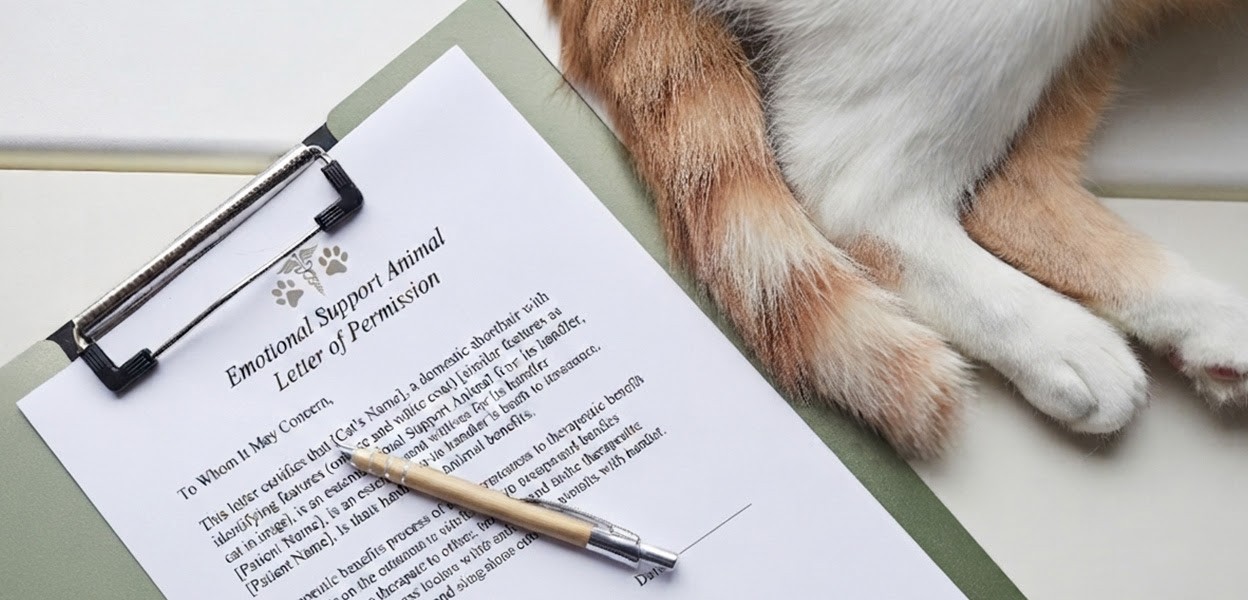
The problem comes in the legitimacy of the letters.
During the heyday of the exploitation of ESAs (just a few years ago), there were many websites where you could simply buy an ESA letter. These sites had a doctor somewhere rubber stamping the letters, but the letters themselves were basically form letters saying "I, Doctor X, affirm that Patient Y has Mental Illness Z and can benefit from an ESA."
While technically within the bounds of the law, this is an obvious exploit of the system, and it's a huge part of why the laws have changed in the last few years.
To be clear: you can still get a valid emotional support animal letter from your mental health doctor. Unfortunately, the rights it grants you are a lot smaller than they used to be.
Are all emotional support animals a scam?
This is a tricky question to answer.
Obviously, no, emotional support animals themselves are not a scam. Animals can give a lot of comfort through their unconditional love and bond. There's a valid use case for them, and even a trained service animal can be used to comfort individuals with PTSD and anxiety.

The scam comes in the "letter mills" online, which issue form letters for a fee and have caused all of the problems we've mentioned so far. When people are using a minor mental illness (or even no diagnosed illness at all), along with a one-time fee to a company online, to get out of pet limitations on housing, it's pretty clearly an abuse of the system.
We still support the idea of emotional support animals, but they need to be handled properly, and unfortunately, they simply don't provide as many benefits as they used to.
Should You Consider Getting an Emotional Support Animal Letter?
If you have a mental illness that has been diagnosed, you're working with a therapist or other mental health professional, and you believe that an emotional support animal could help you in your daily life, then sure, you can talk to your doctor about an ESA letter.
That said, to us, it's more about connecting you with a resource that can help you than it is about the letter itself. You don't need a letter to have a pet that loves and supports you.

The main reason why people sought these letters is to be able to bring their ESAs into housing that otherwise doesn't accept pets, or that has high pet fees added onto rent. With recent changes to the federal laws, this benefit doesn't really exist anymore.
So, if you can afford the fees or have housing that allows pets, there's no reason not to get an emotional support animal, with or without the letter. If you can't, the letter isn't going to do you any good unless you're in government-subsidized housing.
While an emotional support letter from office is not guaranteed, the first step in this process eis seeking treatment for your mental health. Here at BMC-Troy, we can help you from the very first evaluation throughout your mental health journey. Once you're a patient with our clinical staff, you can discuss the prospects of an ESA letter directly. So, why not get started? Just fill out our new patient intake form or give our office a call at 248.528.9000.