

Insurance coverage is one of the biggest hurdles to seeking care, both physical and mental, in the United States.
In Michigan, millions of people are reliant on Medicaid for their healthcare coverage. Individuals and families who fall under the Medicaid income limit are able to get coverage. We’ve also enacted the Healthy Michigan Plan, a state-level Medicaid expansion that opens coverage for many people who earn too much to qualify for standard Medicaid, but not enough for regular health insurance to be affordable.
While most people think of health insurance as covering physical health (and not even all of that, as anyone with vision or dental problems knows), relatively few people think about how that same insurance covers mental health.
Due to the Affordable Care Act, most health insurance plans are required to cover mental healthcare and substance abuse treatment services equally to physical healthcare. By federal law, all healthcare plans must cover behavioral health treatment, including psychotherapy and counseling, mental and behavioral health inpatient services, and substance use disorder treatment.
Where things get murky is treatments that fall outside of the clearly defined categories, such as couples therapy. While couples therapy can easily be considered mental health treatment or counseling, it’s also focused on two people rather than one, who may have different insurance coverage, and the details get tricky.
We also live in a time of rapid change, where everything from federal budgets to state administration of programs to policy changes happens with little warning and little time to adjust. In particular, recent cuts to Medicaid at the federal level are having a significant (negative) impact on who gets Medicaid and what Medicaid covers.
All of that is, understandably, a stressful environment to try to seek therapy. When you aren’t sure if you’re even going to still have coverage, or if that coverage actually covers (or will continue to cover) your treatments, it’s hard to want to commit.
So, what is the state of Michigan’s Medicaid coverage here at the end of 2025, moving into 2026? Does it cover couples therapy, and will it continue to do so? We’ve done the digging to find out what we can.
DISCLAIMER: This article is for informational and educational purposes only and should not be considered medical or psychological advice. The information presented here is not intended to diagnose, treat, cure, or prevent any mental health condition or replace professional therapeutic care. Every individual's experience with trauma and mental health is unique. Please consult with a qualified mental health professional, therapist, or healthcare provider to determine the most appropriate treatment approach for your specific situation. If you are experiencing a mental health crisis or emergency, please contact your local emergency services or crisis hotline immediately.
Direct Coverage of Couples Therapy and Marriage Counseling
First, the bad news: Medicaid in general is unlikely to cover couples therapy across the board.
This is because Medicaid is primarily aimed in two directions: for medically-necessary treatment, and for individual treatment.
Even more traditional insurance programs also frequently choose not to cover couples therapy, marriage counselling, and similar relationship maintenance therapy.

On one hand, you can kind of see the reason for it. While therapy for something like anxiety or PTSD can be deemed medically necessary to live a healthy life, a relationship is not a necessity; something like divorce is equally as much of an option, and single people aren’t living lesser lives because of the lack of a relationship.
On the other hand, an institutional policy of “relationships aren’t important to us” isn’t all that beneficial, right? Human beings are social creatures, and relationships of various kinds truly are a requirement for a healthy life.
Unfortunately, it has been enough of an uphill battle just to get mental healthcare recognized as valid and necessary in this country; the fight to recognize healthy social dynamics and relationship counseling as equally valid is still ongoing. One day, we’ll get there as a society, but today does not seem to be that day.
Coverage of Couples Therapy on a Per-Plan Basis
One thing that many people don’t necessarily know until they’re dealing with Medicaid is that Medicaid, despite being federally managed, is not one entity. Instead, health insurance companies provide Medicaid plans to their regions, with specific plan details just like any other healthcare plan. Each company has to meet the mandatory minimums for coverage to adhere to federal and state-level laws, but the specific details beyond that are not fixed.
In Detroit (specifically in Wayne County and Oakland County), there are a handful of specific insurance companies offering their services as Medicaid providers. Both Wayne County and Oakland County have the same list:
- Aetna Better Health of Michigan
- Blue Cross Complete of Michigan
- HAP CareSource
- McLaren Health Plan
- Meridian Health Plan of Michigan
- Molina Healthcare of Michigan
- Priority Health Choice
- United Healthcare Community Plan
The specific details of each plan vary, as do the list of providers who accept those plans.

Throughout the greater Detroit area, there are a lot of different therapists and mental health providers who offer couples therapy and marriage counselling services. Many of those providers will accept Medicaid insurance for their services. Some of them will offer marriage counseling, couples therapy, and other not-quite-required services. Sometimes they do this through a loophole, which we’ll talk about a bit more in a moment.
Realistically, though, most of these plans are the same when it comes to couples therapy: you’re on your own. It’s unfortunate, but the line has to be drawn somewhere, and right now, that’s where it is.
Coverage Loopholes for Covered Couples Therapy
Calling these loopholes isn’t quite accurate; providers aren’t doing anything against the rules, and the insurance providers are willing to cover the services on offer. It just might not work exactly the way you would think.
There are a few different ways you might have covered couples therapy under Medicaid, depending on the provider and their discretion.
The first is through individual therapy. Couples therapy is not covered, but individual therapy is. Frequently, the root cause of issues and friction in a relationship stems from individual issues, from anxiety to OCD to substance use.
A provider can provide de facto couples therapy simply by working with each member of the couple individually, and occasionally bringing them in for each other’s sessions. This is often a valid strategy for individual therapy when interpersonal relationships are involved, as it is, so it’s not unusual for it to be more formalized as a couple-beneficial individual therapy.
The truth is, even getting individual therapy with a focus on relationship issues can be a lot better than struggling to find affordable couples therapy. Even if your partner doesn’t attend most sessions or therapy themselves, any source of treatment can be a net benefit.

The second is through group therapy with an individual focus. Group therapy is generally classified as an individual treatment option for each participant, even though the format of the session is as a group. Group therapy can provide a similar benefit to couples therapy if it’s focused on relationship issues and both members of the relationship attend.
The downside to this approach is the group setting. With standard couples therapy, the “dirty laundry” of the relationship stays between you and your therapist. In a group setting, other couples may be involved, which can make it harder to be forthcoming with discussions. Still, it can be an option.
The third is through cost adjustments like sliding fee scales for pre-existing patients. This is a way to get couples therapy at a low cost, but it isn’t actually categorized as covered by Medicaid since no insurance is involved at all.
Not all therapy providers offer sliding fee scales or low-cost treatment for low-income patients. You’ll likely need to call around and ask various providers in the Detroit area whether or not they offer the kinds of services you need. You can also use resources like our list of free support groups in the Detroit area as a place to start looking.
A fourth, potentially risky option is through third-party service providers. There are a variety of health-focused tech companies and service providers out there that will accept Medicaid for just about any service. They aren’t always transparent about what they’re doing or who is providing care, however, so they can be tricky to consider reliable. The inherent risk is why we’re not listing names.
Changes to Michigan Medicaid in 2026
You may have caught wind of the news or heard through mailers that there are likely to be changes to Medicaid in the coming year. This is true, though the actual changes aren’t necessarily what you may have heard they would be.
Broadly speaking, two things are changing in 2026.
The first is standardization.
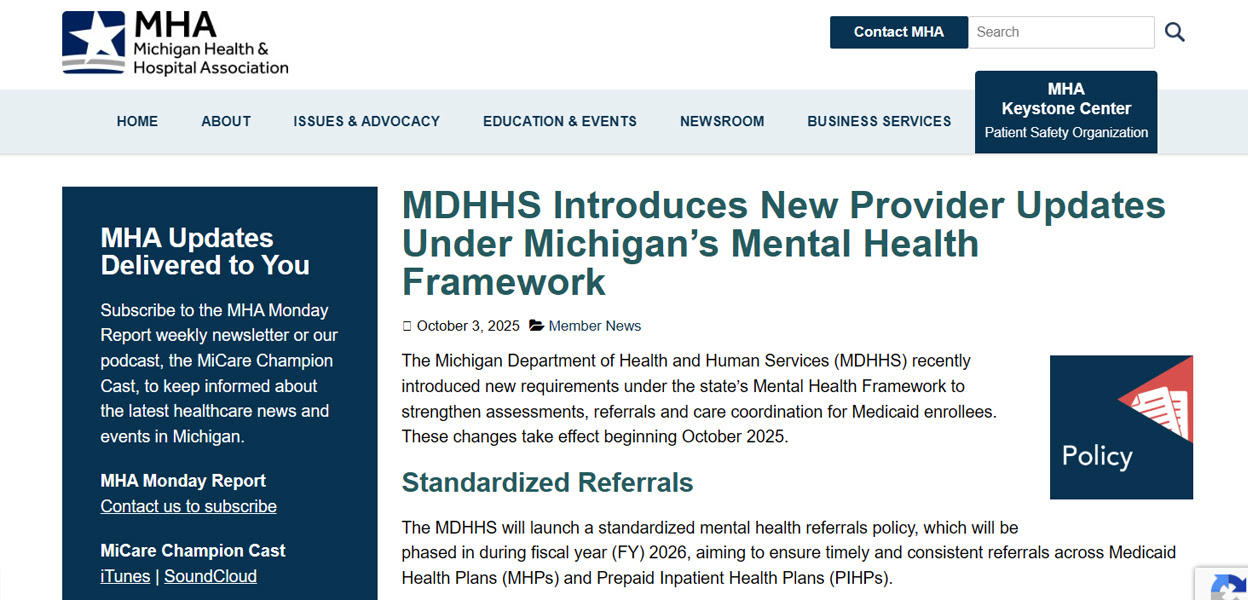
Specifically, along with the ongoing plan to streamline and equalize the healthcare options and treatment available to Michigan citizens, two processes are being standardized across the state of Michigan.
- Assessments. Assessments are a key part of seeking mental health treatment, but until now, individual providers had a lot of discretion to assess patients and make decisions. Those decisions were often highly variable from provider to provider, and could result in individuals not receiving the care they deserve. To combat this, all providers qualified to provide assessments are required to use either the MichiGANS system (for anyone under the age of 21) or the LOCUS system (for anyone 21 and older) to assess care needs.
- Referrals. Referral policies have varied across Medicaid plans and providers all throughout the state. This has led to some people being forced to wait inordinately long times for referrals to care, delaying the care they need. 2026 phases in a new policy for standardized referrals using specific systems managed by the state.
The second major change likely to come in 2026 is a significant cut in funding from federal reimbursement. A reduced match rate and reduced budget mean Medicaid will have less money to spend on services, so it covers less, so costs rise, and more people lose coverage.
When this takes effect, whether or not Michigan can offset the loss in other ways, or whether it will be fought or rolled back by Congress, all remains to be seen. As we said above, we live in a time of rapid change, and there’s no way to predict the future of how all of this will shake out.
Suffice to say, seek care as soon as you can, while you’re still able to do so.
Beyond this, there are other changes to Medicaid, but they relate more to physical healthcare, or are slated to take effect in 2027 or later. For example, there may be stricter rules for GLP-1 prescriptions soon, and 2027 is set to add work requirements to eligibility, which will likely cause significant losses of coverage across the state.
How to Find Couples Therapy in the Detroit Area
If you’re seeking couples therapy in Detroit, and you’re hoping to use Medicaid to help cover it, you may be out of luck. But that doesn’t mean you can’t get couples therapy, just that you probably can’t use Medicaid for it.
Before anything else, double-check by calling your Medicaid provider. They can tell you if they cover couples therapy or marriage counseling services, and if so, they can provide you with a list of therapy providers that are in their network in the Detroit area.
If you haven’t chosen your Medicaid provider yet, you can also call each of them and ask if they cover the services you need, so you can pick the one most appropriate for your needs.

In the absence of Medicaid coverage, your best bet is to look for providers who offer couples therapy in the Detroit area, and ask them if they either work with Medicaid or offer services for low cost or on a sliding fee scale. Tools like the Psychology Today Directory can give you a list of therapists to start with.
At BMC-Troy, we offer many different services in our office, including individual therapy, group therapy, marriage counseling, and medication management to ensure your treatment plan adapts to your needs and changing circumstances. Unfortunately, our marriage counseling is currently not a covered benefit. If you have questions about it specifically, feel free to give us a call.
Even if couples therapy isn’t covered, you can still work with us for individual therapy and counseling, and family therapy is a frequent add-on when interpersonal relationships are involved. Please feel free to reach out and discuss your needs, and we can help discover the right course of action for you.